
Trexmount Ventures
Trexmount

Chulu East Peak Climbing

Adventure Awaits

Chulu East Peak Climbing

Nepal
0 Reviews
Large Image
Image 1
Best Price $3,200.00
Duration 20 Days
Location Nepal
Best Season Mar - May & Sep - Nov
Difficulty Level Strenuous
Max Altitude 6584m
Activity Peak Climbing
Transportation Flight

Overview

Have you ever dreamed of standing on top of a Himalayan peak, with the wind in your face and the world stretching out below you? Chulu East Peak Climbing makes that dream real. Nestled deep in the breathtaking Annapurna region of Nepal, this is one of the most rewarding climbing in Nepal experiences you can find.

Whether you are a seasoned mountaineer or an adventurous trekker stepping into the world of peak climbing, Chulu East is a journey worth every step. With the right Best Trekking Company in Nepal by your side, you can summit this glorious Himalayan giant safely and confidently.

What Is Chulu East Peak?

Chulu East Peak is one of the most popular Annapurna trekking peaks in Nepal. It sits in the Manang district, right along the iconic Annapurna Circuit route. This peak is officially listed as a Chulu East Peak trekking peak, which means it is open to climbers with a special permit from Nepal’s government. Moreover, it is the perfect entry point into the world of high-altitude Himalayan peak climbing.

  • Location: Manang District, Annapurna Region, Nepal
  • Mountain Range: Chulu massif, part of the Annapurna Himalaya
  • Type: Trekking peak / Nepal Peak Climbing Adventure
  • Base Camp Altitude: Approximately 4,800 m (15,748 ft)
  • Summit Altitude: 6,584 m (21,601 ft)

This Nepal peak climbing adventure combines a classic Himalayan trek with a genuine high-altitude summit. As a result, climbers get the best of both worlds, the cultural richness of the Annapurna Circuit with Chulu East, and the thrill of standing on a true Himalayan summit.

FeatureDetails
Peak NameChulu East Peak
RegionAnnapurna, Nepal
Height6,584 m (21,601 ft)
TypeHimalayan Trekking Peak
Best SeasonsSpring (Mar–May), Autumn (Sep–Nov)
Permit RequiredYes, Nepal Mountaineering Association
DifficultyModerate to Strenuous

Why Is Chulu East a Top Himalayan Trekking Peak?

The Chulu East Peak expedition stands apart from many other climbing peaks in Nepal because it blends trekking and technical climbing beautifully. Furthermore, the approach itself follows the world-famous Annapurna Circuit, giving climbers dramatic views of Annapurna I, II, III, IV, and Gangapurna. Consequently, even before reaching the summit, you will have already experienced some of the finest mountain scenery on Earth.

  • Accessible to climbers with basic mountaineering experience
  • Combines seamlessly with the Annapurna Circuit with Chulu East trek
  • Offers panoramic views of the entire Annapurna Himalaya
  • Supported by well-established teahouse infrastructure along the route

What Is the Height of Chulu Far East Peak? | Chulu East Peak Altitude Explained

One of the most common questions climbers ask is about the Chulu East Peak altitude. Understanding the height is essential because altitude directly affects your body, your acclimatisation plan, and your overall safety. Chulu East Peak stands at 6,584 meters (21,601 feet) above sea level. This makes it a genuine high-altitude Himalayan peak, well above the 6,000-meter threshold that many mountaineers aspire to cross. Notably, there is sometimes confusion between Chulu East and Chulu Far East, these are two separate sub-peaks of the same massif.

PeakAltitudeDifficulty
Chulu East Peak6,584 m (21,601 ft)Moderate–Strenuous
Chulu Far East Peak6,059 m (19,879 ft)Moderate
Chulu West Peak6,419 m (21,060 ft)Strenuous

How Altitude Affects Your Chulu East Peak Climb

At 6,584 meters, the air contains only about 47% of the oxygen available at sea level. Therefore, proper acclimatisation during your Chulu East Peak itinerary is not optional, it is absolutely critical. Additionally, the human body needs time to produce more red blood cells and adapt to lower oxygen levels.

  • Above 5,000 m: Altitude sickness risk increases significantly
  • Above 6,000 m: Supplemental oxygen is sometimes used
  • Gradual ascent (no more than 300–500 m per day above 3,000 m) is recommended
  • Rest days built into the Chulu East Peak climbing itinerary are non-negotiable for safety

How Difficult Is Chulu East Peak Climbing? | Chulu East Peak Difficulty Level

The Chulu East Peak difficulty is often rated as moderate to strenuous, making it suitable for fit trekkers with some prior mountaineering experience. However, it is important to understand exactly what “moderate to strenuous” means in the context of climbing in Nepal at high altitude.

FactorDetails
Technical DifficultyPD+ (Peu Difficile Plus) on Alpine grade scale
Snow Slope Angle40°–55° near the summit
Glacier TravelYes, crampons and an ice axe are required
Fixed RopesYes, crampons and an ice axe required
Minimum ExperienceBasic ice and snow climbing skills
Fitness LevelHigh, long daily trekking + climbing
Altitude Challenge6,584 m, significant altitude management needed

Chulu East Peak Climbing Difficulty Level

The Chulu East Peak climbing difficulty level comes from a combination of altitude, terrain, and duration rather than pure technical complexity. Therefore, even climbers without prior high-altitude summits can succeed with proper preparation.

  • Not technical enough to require prior expedition experience, but not a beginner’s peak
  • Altitude is the biggest challenge, proper acclimatisation is essential
  • Physical fitness matters enormously, you will trek 6–8 hours daily for nearly 3 weeks
  • Mental strength is equally important, especially during the summit push in cold, thin air

Who Can Do the Chulu East Peak Climb in Nepal?

  • Trekkers who have completed the Annapurna Circuit or the Everest Base Camp trek
  • Climbers with basic snow and ice climbing training
  • Anyone in excellent cardiovascular fitness
  • People aged 18–60 with no serious heart or lung conditions

Best Time to Climb Chulu East Peak | Seasonal Guide for Annapurna Region Peak Climbing

Timing your Chulu East Peak expedition correctly is one of the most important decisions you will make. Nepal’s Himalayan weather follows a predictable seasonal pattern, and choosing the right season makes the difference between a safe summit and a dangerous retreat.

SeasonMonthsConditionsRecommended?
SpringMarch–MayStable, warm, clearHighly Recommended
Summer/MonsoonJune–AugustHeavy rain, poor visibilityNot Recommended
AutumnSeptember–NovemberStable, cold, crystal-clearHighly Recommended
WinterDecember–FebruaryExtreme cold, heavy snowFor experienced only

Why Spring and Autumn Are the Best Times to Climb Chulu East Peak

The best time to climb Chulu East Peak falls clearly in spring (March to May) and autumn (September to November). During these windows, the weather is most stable, trail conditions are safe, and mountain views are spectacular.

  • Spring: Rhododendrons bloom, temperatures are pleasant, and summit visibility is excellent
  • Autumn: Crystal-clear skies after the monsoon, vibrant landscapes, perfect climbing conditions

Chulu East Peak Climbing Permit & Requirements

Every climber must obtain a Chulu East Peak climbing permit before beginning the expedition. Nepal’s government strictly regulates access to trekking peaks through the Nepal Mountaineering Association (NMA). Furthermore, the Annapurna Conservation Area also requires a separate entry permit.

Permit TypeIssuing AuthorityRequired For
Peak Climbing PermitNepal Mountaineering Association (NMA)Chulu East Peak climbing
ACAP PermitAnnapurna Conservation Area ProjectAnnapurna region trekking
TIMS CardTrekking Agencies’ Association of NepalAll trekkers in Nepal

How to Obtain Your Chulu East Peak Climbing Permit

Your Chulu East Peak climbing guide from Trexmount will handle all paperwork on your behalf. However, it helps to understand the process.

  • Permits are issued by the NMA office in Kathmandu
  • You must apply as part of a registered team with a licensed guide
  • Permits must be obtained before the trek begins, not en route
  • The Best Trekking Company in Nepal will manage all permit logistics for you

Chulu East Peak Preparation & Training | Get Ready for Your Nepal Peak Climbing Adventure

Success on the Chulu East Peak summit begins months before you ever board your flight to Kathmandu. Proper Chulu East Peak preparation and Chulu East Peak training are non-negotiable. Consequently, climbers who prepare thoroughly are far more likely to summit safely and enjoy the experience.

Training AreaRecommended ActivityDuration Before Trip
Cardiovascular FitnessRunning, cycling, swimming3–6 months
Strength TrainingSquats, lunges, core exercises3–6 months
High-Altitude SimulationAltitude tents or pre-trip high altitude hike1–2 months
Technical SkillsBasic ice axe and crampon use1–3 months
Load CarryingLong hikes with a heavy backpack2–4 months

Chulu East Peak Training

Your Chulu East Peak training program should progressively build your endurance and strength. Furthermore, practising with climbing equipment before arrival saves critical time during the expedition and reduces the risk of accidents.

  • Run at least 5 km three times per week, gradually increasing distance
  • Practice long day hikes (6–8 hours) with a 10–15 kg backpack
  • Take a basic mountaineering course if you have no prior snow/ice experience
  • Practice breathing exercises to improve oxygen efficiency at altitude

Chulu East Peak Preparation

In addition to physical training, Chulu East Peak preparation includes assembling the right gear and cultivating the right mindset. For instance, having properly fitted, broken-in boots can make the difference between frostbitten toes and a comfortable summit.

  • Essential gear: crampons, ice axe, harness, helmet, down suit, insulated boots
  • Trekking poles for the approach and descent
  • Layered clothing system, base, mid, and outer shells
  • Sunglasses (glacier-rated), sunscreen, and lip balm (UV radiation is intense at altitude)

Why Choose Trexmount as Your Best Trekking Company in Nepal?

When it comes to Chulu East Peak climbing guide services and full expedition support, Trexmount stands out as the go-to Best Trekking Company in Nepal. Furthermore, Trexmount specialises in Annapurna region peak climbing, Himalayan trekking peaks, and Nepal peak climbing adventure packages tailored to all experience levels.

Why TrexmountDetails
Licensed & CertifiedRegistered with Nepal Tourism Board
Expert GuidesTrained, certified, experienced climbing guides
Safety FirstComprehensive first aid and emergency protocols
Custom PackagesTailored Chulu East Peak climbing package Nepal
24/7 SupportAlways available before and during your trip
Transparent PricingClear, honest Chulu East Peak cost breakdown

Trexmount’s Approach to Chulu East Peak

Trexmount builds every Chulu East Peak itinerary with safety and success at its core. As a result, the company maintains a high summit success rate while keeping clients safe. Additionally, Trexmount’s local expertise means you benefit from up-to-date route conditions, weather information, and community relationships along the trail.

  • All guides are certified by the Nepal Mountaineering Association
  • Porters are fairly paid and properly equipped. Trexmount follows ethical trekking standards
  • Equipment is inspected before every departure
  • Emergency helicopter evacuation protocol is in place for every expedition
Package options

Select Package Type

★ ★ ★ ★ ★

Standard Package Price

US $3200

per traveller

Standard Package Included

  • Airport pick-up and drop-off transfer.
  • Transportation as per the above itinerary.
  • All accommodations (Twin Share)
  • Meals, Breakfast, Lunch, Dinner (as listed in the Itinerary)
  • An experience guide and required number of porters (one porter in between two pax), their food, accommodation, transportation, salary, insurance, equipment, and so on.
  • Warm sleeping bag, warm down jacket and walking stick, if necessary.
  • Trek bag.
  • All Government Taxes are included.

Standard Package Excluded

  • Tips to staff or any donations.
  • Single Supplement for single-use rooms
  • Your travel insurance, Medical and emergency costs (Just in case).
  • All types of drinks (mineral water, any cold drinks, and alcoholic drinks).
  • Any personal expenses that are not mentioned in the price inclusion.

Trip Itinerary

Upon arrival at Tribhuvan International Airport in Kathmandu, our representative will greet you and transfer you to your hotel. After check-in and some rest, you will attend a short pre-departure briefing conducted by your trekking leader. During this meeting, you will receive important information about the expedition, safety procedures, and gear requirements. Our team will also collect necessary documents such as passport copies, travel insurance details, and passport-size photographs for trekking and climbing permits.


Accommodation

Hotel in Kathmandu

Meal

Welcome Dinner

Time

N/A

Distance

N/A

After breakfast, the day is free for final trek preparation, equipment checks, and rest. Alternatively, you may explore the Kathmandu Valley’s UNESCO World Heritage sites on an optional sightseeing tour. Popular destinations include the sacred Pashupatinath Temple, the massive Boudhanath Stupa, the hilltop Swayambhunath Stupa (Monkey Temple), and the historic Durbar Squares of Kathmandu, Patan, or Bhaktapur. These locations showcase Nepal’s rich culture, architecture, and religious traditions. Sightseeing can be arranged locally depending on your interest.


Accommodation

Hotel

Meal

Breakfast

Time

N/A

Distance

N/A

After breakfast, we begin an overland journey from Kathmandu toward Chamje. The scenic drive follows winding mountain roads through terraced fields, river valleys, and traditional villages. Passing the town of Dumre, we leave the main highway and continue toward Besisahar, the administrative center of Lamjung District. From here the road becomes rougher as we follow the Marsyangdi River upstream through villages such as Khudi, Bhulbhule, and Ngadi. By late afternoon we reach Chamje, a small village with basic lodges surrounded by lush hills.


Accommodation

Hotel / Teahouse

Meal

Breakfast, Lunch, Dinner

Time

7-8 hours

Distance

N/A

Today we begin trekking along the Annapurna Circuit trail. After crossing the Marsyangdi River, the trail climbs through forests and alpine landscapes with views of Annapurna and Lamjung Himal. We pass waterfalls and terraced farmland before reaching Tal, a beautiful village located in a wide valley. Continuing through forested trails and stone pathways, we gradually ascend toward Dharapani. This village serves as an important junction connecting the Annapurna Circuit and Manaslu trekking routes.


Accommodation

Hotel / Teahouse

Meal

Breakfast, Lunch, Dinner

Time

5-6 Hours

Distance

11 km

Leaving Dharapani, the trail gradually climbs through dense pine and rhododendron forests. We pass small villages such as Bagarchap, Danaque, and Timang, where spectacular views of snow-covered Himalayan peaks appear. From Timang, the trail descends slightly before continuing toward Koto and eventually reaching Chame, the administrative center of Manang District. Chame is known for its hot springs and stunning views of Lamjung Himal and Annapurna II.


Accommodation

Hotel / Teahouse

Meal

Breakfast, Lunch, Dinner

Time

5-6 Hours

Distance

13km

The trek from Chame follows a beautiful forested trail along the Marsyangdi River. After crossing several suspension bridges and passing through pine forests, we reach the small settlement of Bratang. The valley gradually widens as we continue to Dhukur Pokhari, where dramatic views of Pisang Peak and Chulu peaks begin to appear. From here we descend slightly to Lower Pisang, a traditional village surrounded by stone houses and prayer flags.

Accommodation

Hotel / Teahouse

Meal

Breakfast, Lunch, Dinner

Time

5-6 Hours

Distance

14km

Today we leave the main Annapurna Circuit route and head toward Chulu East Peak. The trail climbs steeply above the Marsyangdi Valley, providing expansive views of the Annapurna range. Passing through the village of Ngawal, we continue across increasingly barren alpine terrain typical of the Manang region. After several hours of climbing and traversing high ridges, we reach Julu, a small remote settlement where we establish our first campsite.


Accommodation

Hotel / Teahouse

Meal

Breakfast, Lunch, Dinner

Time

6-7 hours

Distance

10 km

Proper acclimatization is essential before climbing at higher altitude. Today we spend the day in Julu to allow the body to adjust to the thinner air. Short hikes around the surrounding hills help improve acclimatization while offering panoramic views of the Annapurna and Chulu ranges. Our climbing guide will also conduct a briefing covering climbing techniques, safety procedures, rope use, and equipment preparation for the upcoming ascent.


Accommodation

Hotel / Teahouse

Meal

Breakfast, Lunch, Dinner

Time

N/A

Distance

Optional short hikes

Today’s trek is shorter but physically demanding due to the altitude and rugged terrain. The route follows a faint trail across rocky moraines, glacial debris, and alpine slopes rarely used except by climbers and yak herders. Gradually we gain elevation beneath the impressive Chulu East Peak. Upon reaching the base/high camp area, we set up camp along a ridge with dramatic mountain views. The climbing guide scouts the route and prepares fixed ropes where necessary.


Accommodation

Hotel / Teahouse

Meal

Breakfast, Lunch, Dinner

Time

4-5 Hours

Distance

N/A

This day is reserved for rest, acclimatization, and final preparation for the summit attempt. Climbers practice using climbing gear such as crampons, harnesses, and ropes on nearby slopes if necessary. Our guide reviews the climbing route, weather conditions, and safety procedures for the summit push. The rest of the day is spent resting, hydrating, and preparing equipment to ensure a safe and successful climb.


Accommodation

Hotel / Teahouse

Meal

Breakfast, Lunch, Dinner

Time

N/A

Distance

Optional short training

We begin the summit attempt before dawn, climbing steadily over glacial terrain and snow slopes. The ascent involves roped travel and several steep sections requiring basic mountaineering techniques. Reaching the summit rewards climbers with breathtaking panoramic views of the Annapurna range, Manaslu, and the Chulu peaks. After celebrating the achievement, we carefully descend back to base camp and, if conditions allow, continue further down to Julu or Pisang.


Accommodation

Hotel / Teahouse

Meal

Breakfast, Lunch, Dinner

Time

8-10 Hours

Distance

N/A

This extra day is kept as a contingency in case of bad weather, difficult climbing conditions, or delays during the summit attempt. If the climb is completed earlier, the guide may adjust the itinerary and use this day for additional rest or to continue descending along the Annapurna Circuit route.


Accommodation

Hotel / Teahouse

Meal

Breakfast, Lunch, Dinner

Time

N/A

Distance

N/A

From Julu or nearby villages, we rejoin the main Annapurna Circuit trail and descend gradually toward Manang. Along the way we visit Braga village, home to one of the region’s oldest monasteries, decorated with Buddhist statues and ancient religious texts. After exploring the monastery, we continue a short distance to Manang, a major settlement known for its Tibetan-influenced culture and spectacular mountain scenery.


Accommodation

Hotel / Teahouse

Meal

Breakfast, Lunch, Dinner

Time

4-5 Hours

Distance

9 km

Leaving Manang, the trail gradually climbs through alpine terrain with fewer trees and more open landscapes. Passing Tenki village, we continue along a gentle uphill path toward Ghunsang. Along the way, enjoy impressive views of Gangapurna, Tilicho Peak, and Chulu West. The trail eventually leads to Yak Kharka, a small grazing area where yaks and other livestock are commonly seen.


Accommodation

Hotel / Teahouse

Meal

Breakfast, Lunch, Dinner

Time

4-5 Hours

Distance

9 km

The trail climbs gradually toward Thorong Phedi, the base of the Thorong La Pass. After crossing a suspension bridge and ascending rocky trails, we reach Thorong Phedi for a short rest. From here a steep zigzag path climbs for about an hour to Thorong High Camp. This location offers dramatic views of the surrounding peaks and serves as the final stop before crossing the pass the next morning.


Accommodation

Hotel / Teahouse

Meal

Breakfast, Lunch, Dinner

Time

4-5 Hours

Distance

7 km

We start early to cross the famous Thorong La Pass, one of the highest trekking passes in the world. The gradual climb leads to the pass, marked by prayer flags and signboards. From the top, enjoy panoramic views of the Annapurna and Dhaulagiri ranges. After celebrating the achievement, we descend through barren landscapes toward the sacred pilgrimage site of Muktinath, revered by both Hindus and Buddhists.


Accommodation

Hotel / Teahouse

Meal

Breakfast, Lunch, Dinner

Time

7-8 hours

Distance

15 km

Today’s trek descends through the dry Mustang region. We pass the traditional village of Jharkot and descend toward the Kali Gandaki River valley. The trail follows a wide, windy riverbed until reaching Jomsom, the administrative center of Mustang. Jomsom is famous for its apple orchards and local apple products such as cider and brandy.


Accommodation

Hotel / Teahouse

Meal

Breakfast, Lunch, Dinner

Time

4 hours

Distance

10 km

Early in the morning we transfer to Jomsom Airport for a scenic flight to Pokhara. The short flight offers stunning aerial views of Dhaulagiri, Annapurna, Nilgiri, and Machhapuchhre peaks. Upon arrival in Pokhara, we transfer to our hotel near Phewa Lake. The afternoon is free to relax, explore Lakeside markets, or enjoy the beautiful lakeside scenery.


Accommodation

Hotel / Teahouse

Meal

Breakfast

Time

30m

Distance

N/A

After breakfast, we return to Kathmandu either by scenic flight or by road. The flight takes about 30 minutes and provides spectacular Himalayan views, while the drive follows river valleys and rural landscapes for about 6–7 hours. Upon arrival in Kathmandu, transfer to your hotel and enjoy free time for shopping or exploring the city.


Accommodation

Hotel / Teahouse

Meal

Breakfast

Time

N/A

Distance

N/A

After breakfast, our representative will transfer you to Tribhuvan International Airport for your departure flight. Your adventure in Nepal concludes with unforgettable memories of trekking, climbing, and experiencing the rich culture of the Himalayas.

Meals: Breakfast

Accommodation

Not Included

Meal

N/A

Time

N/A

Distance

N/A

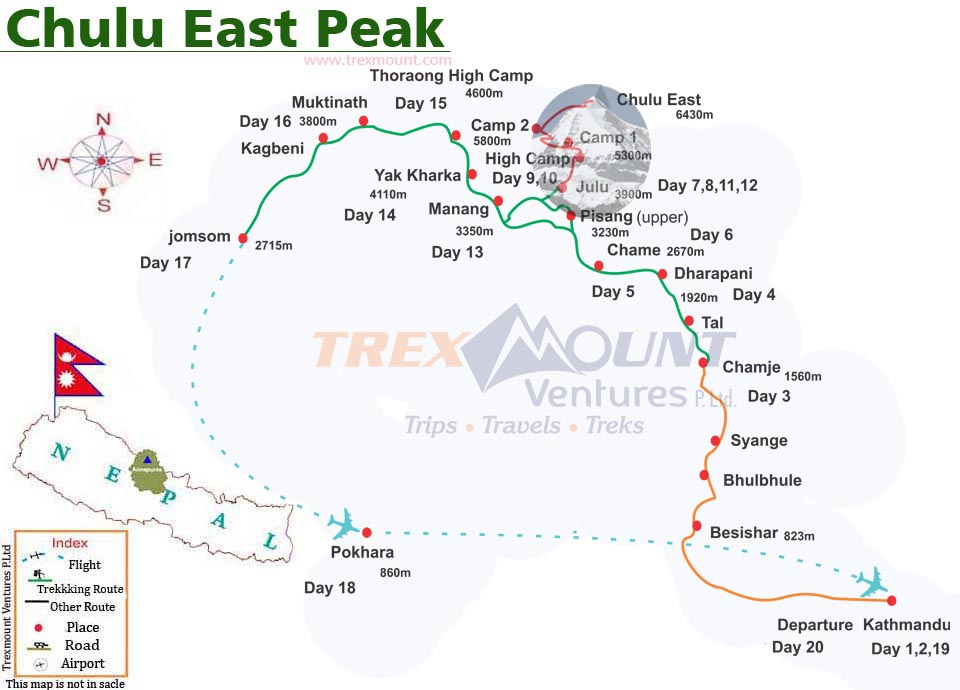
Route Map

trip route map for Chulu East Peak Climbing

Fixed Departure

Frequently Asked Questions

The standard Chulu East Peak climbing itinerary runs for 20 days. This includes travel days in Kathmandu, the approach trek along the Annapurna Circuit, acclimatisation days, summit days, and the return trek. However, some climbers opt for shorter or extended versions depending on their experience and goals. The 20-day format is recommended because it includes essential acclimatisation rest days, which dramatically increase summit success rates and reduce the risk of altitude sickness. Rushing the itinerary is one of the most common mistakes in climbing in Nepal.

Yes, some prior experience is strongly recommended. Specifically, you should be comfortable using crampons and an ice axe, and you should understand basic rope techniques. The Chulu East Peak climbing difficulty level involves snow slopes up to 55°, so beginner-level trekkers without any technical training may struggle. However, you do not need to be a professional mountaineer. A basic mountaineering course, combined with excellent physical fitness, is sufficient preparation for most healthy, motivated climbers. Your Chulu East Peak climbing guide from Trexmount will provide on-route instruction as well.

The best time to climb Chulu East Peak is during spring (March to May) and autumn (September to November). During these seasons, weather conditions in the Annapurna region are most stable, with clear skies and manageable temperatures. Spring brings blooming rhododendrons and warmer days, while autumn offers crystal-clear post-monsoon visibility. Both seasons are ideal for Annapurna region peak climbing and are the busiest periods for Nepal peak climbing adventure expeditions. Avoid the monsoon season (June–August) when heavy rainfall makes trails dangerous and views disappear behind clouds.

For your Chulu East Peak expedition, you need two main permits. First, a Peak Climbing Permit issued by the Nepal Mountaineering Association (NMA) in Kathmandu. Second, an Annapurna Conservation Area Permit (ACAP). Additionally, all trekkers in Nepal need a TIMS (Trekkers’ Information Management System) card. Your Best Trekking Company in Nepal, Trexmount, will arrange all of these on your behalf before the trek begins. Attempting to climb without valid permits is illegal and can result in serious penalties.

You need to be in excellent physical condition. Chulu East Peak preparation requires months of cardiovascular training, running, hiking with a loaded pack, and strength exercises. On the expedition itself, you will trek 6–8 hours daily for nearly three weeks, reaching an altitude of 6,584 meters. Therefore, your heart and lungs must be strong enough to work efficiently in thin air. Begin your Chulu East Peak training at least 3–6 months before departure. Climbers who arrive well-prepared have significantly higher summit success rates on Himalayan trekking peaks like Chulu East.

A comprehensive Chulu East Peak climbing package in Nepal from Trexmount typically includes airport transfers, all ground transportation, teahouse and camp accommodation, full-board meals, all required permits, an experienced climbing guide, porters, high camp tent support, safety and first aid equipment, and an emergency evacuation plan. Some packages also include sleeping bags and down jackets for rent. It is important to confirm what is included and excluded before booking. A transparent, licensed Best Trekking Company in Nepal will provide a clear written breakdown of all costs and inclusions upfront.

Absolutely, and this is actually the standard approach! The Annapurna Circuit with Chulu East is one of the most popular and rewarding mountain adventures in Nepal. The Chulu East Base Camp approach begins from Manang, which sits directly on the Annapurna Circuit trail. After the summit, many climbers continue the circuit by crossing Thorong La Pass (5,416 m) and descending to Muktinath and Jomsom. This combination delivers both a genuine summit of Chulu East Peak and the full Annapurna Circuit experience, two iconic climbing adventures in Nepal in one unforgettable trip.

For the Chulu East Peak trekking peak, your essential gear list includes: mountaineering boots (double-layered, insulated), crampons (12-point), ice axe, climbing harness, helmet, carabiners and prusik cords, a down sleeping bag (rated to -20°C), a four-season down jacket, moisture-wicking base layers, insulated mid-layers, waterproof outer shell jacket and pants, trekking poles, and UV-protective sunglasses. Trexmount provides a detailed gear list as part of your Chulu East Peak climbing guide package. Renting quality gear in Kathmandu is also possible if you don’t want to carry heavy equipment from home.

Altitude sickness (Acute Mountain Sickness, or AMS) is a real risk on any climbing peaks in Nepal expedition above 3,000 meters. At the Chulu East Peak altitude of 6,584 meters, oxygen levels are roughly half of those at sea level. Symptoms of AMS include headache, nausea, dizziness, fatigue, and loss of appetite. Serious conditions include High Altitude Pulmonary Edema (HAPE) and High Altitude Cerebral Edema (HACE), both of which are medical emergencies. Therefore, your Chulu East Peak itinerary must include mandatory acclimatisation days. Trexmount guides are trained to recognise and respond to altitude sickness immediately.

Trexmount is widely recognised as the Best Trekking Company in Nepal for a reason. With years of experience leading Chulu East Peak climb in Nepal expeditions, Trexmount offers expert guidance, ethical operations, transparent pricing, and a genuine commitment to client safety and satisfaction. Moreover, Trexmount’s guides are certified by the Nepal Mountaineering Association and hold extensive knowledge of Annapurna trekking peaks and Himalayan trekking peaks routes. From permit processing to summit day support, Trexmount handles every detail so you can focus entirely on the most important thing — reaching the Chulu East Peak summit and creating memories that last a lifetime.

Traveler Reviews

Verified customer feedback

Related Packages

You May Also Love And Like
Everest Base Camp Trek
(5.0) 19
Nepal
16 Days
Max 50 People
Starts From $1470
Everest Three Passes Trek
(5.0) 14
Nepal
20 Days
Max 30 People
Starts From $2010
Annapurna High Pass Trekking
(5.0) 12
Nepal
14 Days
Max 50 People
Starts From $1280
Annapurna Overview Trek Nepal
(5.0) 12
Nepal
8 Days
Max 50 People
Starts From $1280
Annapurna Panorama Trekking
(5.0) 13
Nepal
8 Days
Max 50 People
Starts From $770
Australian Camp Trekking
(5.0) 16
Nepal
8 Days
Max 50 People
Starts From $500
Mardi Himal Nepal
(5.0) 17
Nepal
10 Days
Max 50 People
Starts From $800
Poon Hill Trek
(5.0) 15
Nepal
10 Days
Max 50 People
Starts From $870
Khair lake Panorama Trekking
(5.0) 14
Nepal
14 Days
Max 50 People
Starts From $1410
Nar Phu Trekking
(5.0) 18
Nepal
20 Days
Max 50 People
Starts From $1790
Panchase Trekking
(5.0) 15
Nepal
12 Days
Max 50 People
Starts From $980
Gokyo Lake Trek
(5.0) 16
Nepal
15 Days
Max 50 People
Starts From $1610
Everest Panorama Trekking
(5.0) 11
Nepal
12 Days
Max 50 People
Starts From $1210
Everest View Hotel and Chopper flight
(5.0) 16
Nepal
14 Days
Max 11 People
Starts From $1888
Mani Rimdu Festival
(5.0) 19
Nepal
13 Days
Max 50 People
Starts From $1780