 Trexmount Ventures
Trexmount Ventures
Trexmount Ventures

Popular Searches
Ready to plan your next getaway? Let’s connect and create something incredible together.
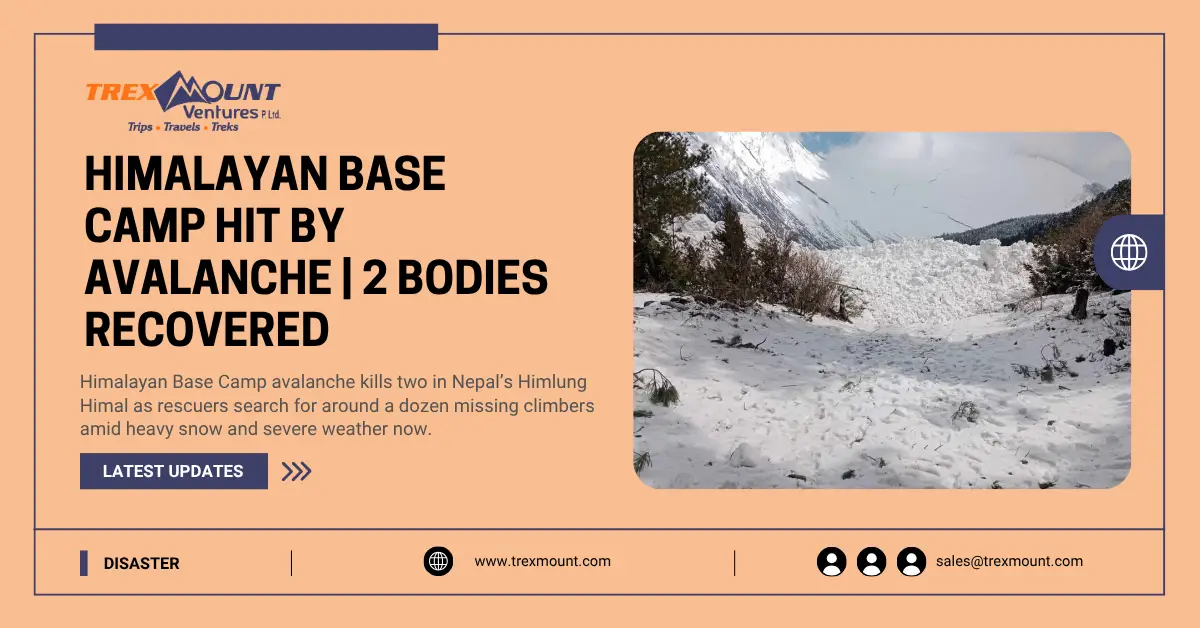




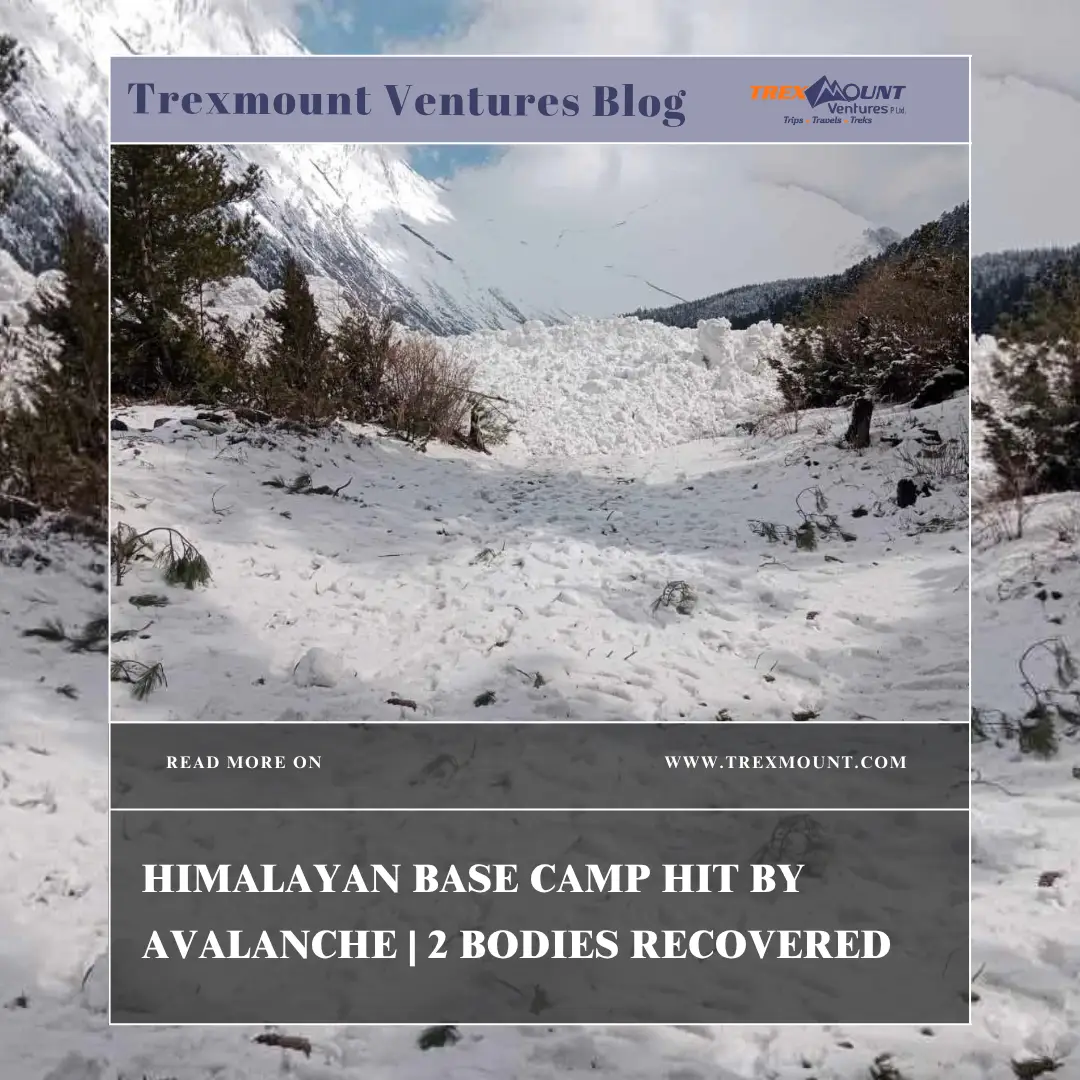
An avalanche has struck the Himalayan Base Camp of Himlung Himal in Nepal’s Manang district, killing at least two people and leaving around a dozen others missing as rescue teams search through snow and difficult mountain conditions.
The avalanche hit the base-camp area of the 7,126-metre Himlung Himal on Sunday morning, September 27, in the remote Nar Phu region of Manang. The people caught in the disaster were Nepali members of an expedition team, including mountain guides, Sherpas and support staff who had travelled ahead to prepare the mountain for foreign climbers.
Two bodies have since been recovered from the avalanche site. Their identities were initially not confirmed, while search teams continued working in the area. The rescue operation has been complicated by persistent snowfall, poor visibility, damaged communications and difficult access to the high-altitude base camp.
The incident has occurred during a period of severe weather across Nepal, with heavy rain, snowfall, floods and landslides affecting different parts of the country. Nepal's weather authorities had also issued warnings as conditions deteriorated in the days leading up to the avalanche.
For the mountain tourism industry, the incident is significant because it happened just as Nepal's autumn climbing and trekking season was getting underway.
The avalanche struck the base-camp area of Himlung Himal on Sunday morning.
Himlung Himal rises to 7,126 metres and is located in the Nar Phu region of Manang district, close to Nepal's northern border with Tibet. The mountain is considered an important climbing peak for mountaineers looking to gain experience at elevations above 6,000 metres.
The initial reports from Sunday said that 10 people were unaccounted for. As rescue coordinators collected more information, the number reported missing increased, with The Kathmandu Post reporting that as many as 14 Nepali members of the expedition could not initially be contacted.
Later that day, rescuers recovered two bodies from the avalanche site.
The changing figures reflect the difficulty of establishing the exact situation immediately after an avalanche in such a remote environment. Different expedition operators and authorities were receiving information from people at different locations, while communication in the area was also affected.
The most consistent picture from later reporting is that:
That final point is particularly important. Reports indicate that the Nepali team had gone ahead of the foreign clients to prepare the base camp, manage the route and fix ropes.
The recovery of two bodies marked the first confirmed fatalities from the Himlung avalanche.
A search and rescue team travelling from Kathmandu reached the Himlung area and recovered the bodies, according to the Nepal National Mountain Guides Association. The identities of the victims were initially unknown.
Another report said the bodies were transported by helicopter to Chame, while the search operation was eventually suspended for the night because darkness made further rescue work dangerous. Officials said the search would resume the following day.
The recovery operation illustrates the difficult conditions facing rescuers.
At more than 7,000 metres, Himlung is an extreme high-altitude environment. Reaching the base camp is itself challenging, and an avalanche can bury tents, equipment and people under large quantities of compacted snow.
Rescuers therefore have to balance the urgency of finding missing people with the danger of entering an unstable avalanche area.
The operation has involved mountain guides, expedition operators, government agencies and helicopter teams working together to locate those still missing.
The people at the base camp were not simply tourists gathered for a trek.
They were part of an organised mountaineering operation preparing for a climbing expedition.
Reports from The Kathmandu Post said the Nepali team included:
The Nepali crew had travelled ahead of foreign climbers who were expected to arrive several days later. The foreign expedition members therefore were not present when the avalanche struck.
This distinction matters because some early headlines referred broadly to “climbers” or an “expedition team.” The people reported missing included both climbing personnel and support staff.
The incident is consequently also a reminder of the risks faced by the Nepali workers who make high-altitude expeditions possible.
Before international climbers reach a mountain, local teams often have to prepare camps, establish routes, carry supplies, fix ropes and organise logistics at extreme elevations.
The biggest immediate obstacle was the weather.
Helicopters were placed on standby in Kathmandu and Pokhara, but poor weather prevented aircraft from immediately reaching the mountain. Visibility and flying conditions were not suitable for a straightforward rescue operation.
The situation was made more difficult because people attempting to reach the area by land also faced challenging conditions.
Reports indicated that rescuers had to wait for a suitable break in the weather before helicopters could safely approach the mountain. The Department of Tourism was coordinating with other agencies while private helicopter operators and experienced mountain guides prepared for the rescue.
There were several challenges at the same time:
This combination meant that simply sending more people to the site was not necessarily possible.
In high-altitude rescue operations, weather can determine whether a helicopter can land, whether rescuers can safely approach an avalanche zone and whether additional teams can be transported to the affected area.
The Himlung avalanche did not happen in isolation.
Nepal had already been experiencing persistent rain and snowfall in several mountain districts before the incident. The Department of Tourism was monitoring the deteriorating conditions, while the country's weather authorities had warnings in effect. Nepal's Department of Hydrology and Meteorology maintains warning and monitoring systems covering hazards including snowfall, landslides, lightning, cold weather and avalanches.
Reports from Manang also indicated worsening conditions in high-altitude areas.
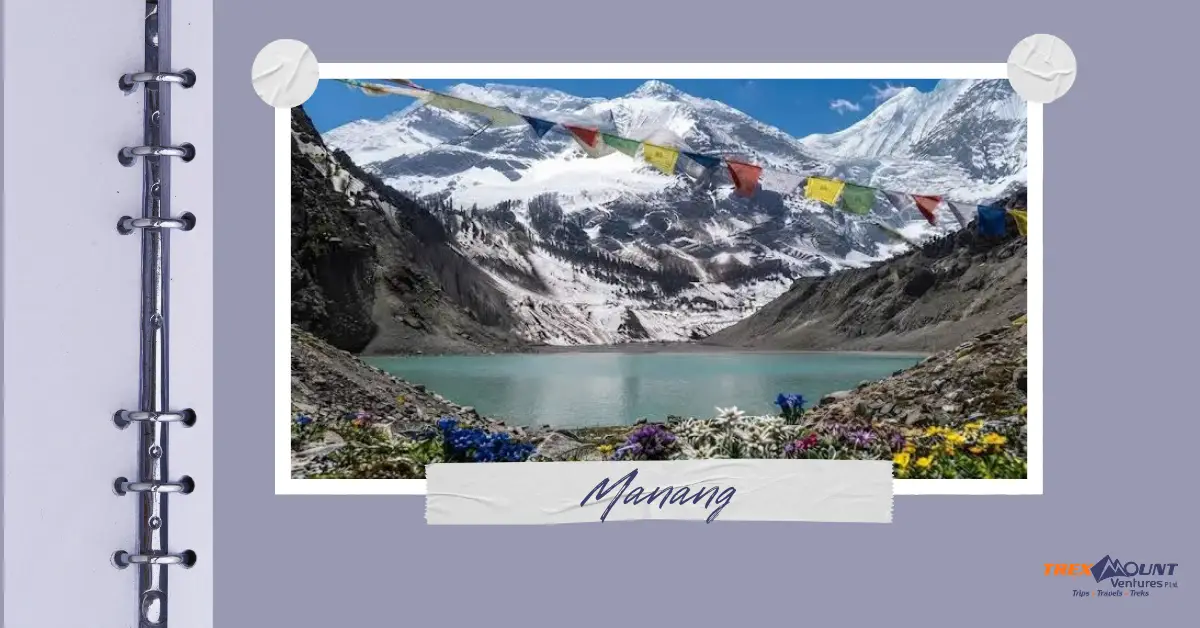
The weather was significant enough that authorities had imposed temporary restrictions on some high-altitude trekking activities in Manang, including areas around major destinations such as Tilicho Lake and Thorong La.
That means the Himlung incident came during a period when authorities were already concerned about conditions in the Himalaya.
The combination of fresh snow, existing snowpack, wind and rapidly changing mountain weather can make high-altitude terrain considerably more unpredictable.
While the avalanche was unfolding in Manang, other parts of Nepal were dealing with heavy rain, flooding and landslides.
Reuters reported on September 27 that heavy rain and storms had triggered floods and landslides across Nepal, with 14 deaths and 11 people missing reported in the country at that stage. Authorities were also warning of further flash-flood risks.
This broader weather situation is important when understanding the Himlung rescue.
Nepal's emergency services were not responding to a single isolated mountain incident. Different parts of the country were simultaneously dealing with weather-related hazards.
Roads and communication networks in some areas were affected, while rivers were rising and landslides were disrupting transportation.
In the mountains, meanwhile, snowfall and poor visibility created another set of dangers.
Himlung Himal is situated in the remote Nar Phu region of Manang, an area known for its rugged Himalayan landscape, high mountain passes and traditional villages.
The Nar Phu Valley lies in northern Manang and is one of Nepal's more remote mountain regions. Access to the area is considerably more demanding than on some of Nepal's heavily developed trekking routes.
The Himalayan Base Camp at Himlung is therefore not comparable to a low-altitude settlement or an easily accessible trekking stop.
Emergency access is inherently difficult.
A helicopter may be the fastest way to reach a high-altitude accident site, but aircraft operations in the Himalaya depend heavily on visibility, wind, cloud cover and landing conditions.
When those conditions deteriorate, rescuers may have very few alternatives.
That is precisely what made Sunday's avalanche so challenging.
One of the most important details in the story is the changing number of people reported missing.
Early reporting from The Kathmandu Post said 10 people were initially unaccounted for, including members of Imagine Nepal and Himalayan Holidays Nepal.
Later reports from the same newspaper said the number had risen to 14, after expedition coordinators gathered additional information about people who could not be contacted.
After two bodies were recovered, other international reports described around a dozen people as still missing. Associated Press reporting put the number at 12 missing after the two deaths, while other reports continued to use figures of 10 or 14 depending on when their information was collected.
For this reason, it is important not to present an early figure as if it were a final official casualty count.
The rescue operation was still developing, and authorities were continuing to reconcile information from expedition companies, guides and people at the mountain.
September traditionally marks the transition toward Nepal's major autumn trekking and mountaineering season.
Mountains such as Everest, Manaslu and peaks in the Annapurna region attract large numbers of international visitors during the post-monsoon period.
But the Himlung avalanche demonstrates an important reality about the beginning of the season:
The arrival of autumn does not automatically mean every high-altitude route is immediately safe or operational.
Mountain conditions can change quickly.
For trekkers and climbers, conditions at the start of a journey can be very different from those encountered at higher elevations several days later.
The current situation highlights the importance of:
These precautions are particularly important in remote regions where medical facilities and roads may be far away.
The Himlung avalanche is a serious incident, but it should not automatically be interpreted as meaning that every trekking route in Nepal has been closed.
Conditions differ significantly from one region to another.
A weather system affecting northern Manang can create completely different conditions from those experienced around Kathmandu, Pokhara or lower-elevation sections of a trekking route.
At the same time, travellers should not ignore the wider weather warnings simply because their planned destination is outside the immediate avalanche area.
The current situation demonstrates why route-specific information is more useful than blanket statements about Nepal's trekking season.
The Department of Tourism has been monitoring the situation, while Nepal's Department of Hydrology and Meteorology provides official weather and hazard information.
Anyone planning to travel into Nepal's high mountains during this period should treat weather conditions as an active part of the trip rather than a minor inconvenience.
Before leaving Kathmandu or Pokhara, travellers should check:
A clear morning in Kathmandu does not mean that a high mountain route will have clear conditions.
This difference is particularly important for itineraries involving remote valleys, high passes and base camps.
The phrase “Himalayan Base Camp hit by avalanche” can sound like a mountaineering headline, but the people involved were workers as well as climbers.
Nepali Sherpas, guides, kitchen workers and other support staff form an essential part of Nepal's expedition industry.
They often travel into difficult terrain before international climbers arrive.
They establish camps, transport equipment, prepare food, manage supplies, fix ropes and help climbers move safely through challenging sections of a mountain.
The Himlung disaster therefore affects more than a single expedition.
It has placed a spotlight on the risks faced by the local mountain workforce that supports Nepal's international climbing industry.
The recovery of two bodies has made those risks tragically concrete.
Following the avalanche, the Nepal National Mountain Guides Association deployed an eight-member search and rescue team, while experienced guides and helicopter crews were mobilised to assist the operation.
Rescue efforts were also being coordinated with government agencies and private expedition operators.
The operation was temporarily halted after darkness and difficult conditions made further searching unsafe, with officials saying the search would resume.
The focus remains on locating the people who are still missing.
Every additional hour matters in an avalanche rescue, but rescuers also have to account for the possibility of unstable snow and further hazards.
That makes the operation a race against time as well as a test of logistics, weather forecasting and mountain rescue expertise.
The Himlung avalanche remains a developing story.
The confirmed facts are clear: an avalanche struck the Himlung Himal base-camp area on September 27; two bodies have been recovered; and a group of Nepali expedition members remained missing in the subsequent reports.
The exact number of people still unaccounted for has varied between reports as authorities and expedition operators continued to verify the situation.
What is also clear is that the rescue has been heavily affected by severe weather.
The incident comes at a difficult moment for Nepal, with heavy rain, snowfall, floods and landslides affecting different regions and creating multiple challenges for emergency responders.
For Nepal's tourism industry, the event is a reminder that the autumn season begins with a period of transition rather than an instant return to stable mountain conditions.
The immediate priority is the search for the missing people.
Rescuers are expected to continue examining the avalanche area as weather and visibility allow. Helicopters and mountain rescue personnel remain central to the response because of the remote location and difficult terrain.
Authorities will also need to identify the recovered victims and establish a more precise account of everyone who was present at the base camp when the avalanche struck.
Further information may therefore change the current casualty and missing-person figures.
For travellers, the more important lesson is straightforward: high-altitude conditions should be checked locally and immediately before entering the mountains.
The Himalaya can change rapidly, particularly when snowfall, rain and strong weather systems occur together.
The Himlung avalanche is one of several serious weather-related events Nepal has experienced in a particularly difficult period.
The country is still dealing with the consequences of major flooding and landslides from earlier in the year, while new rainfall has caused additional disruption across parts of Nepal. Reuters reported that the latest spell of heavy rain had already caused deaths and missing-person cases before the Himlung avalanche.
Against that background, the incident at Himlung Himal is not simply a story about one mountain.
It shows how quickly severe weather can affect Nepal's transport networks, trekking routes, expedition schedules and emergency response capabilities.
It also highlights the importance of accurate information during a developing disaster.
Early numbers can change.
Initial reports can be incomplete.
Weather can prevent rescuers from reaching an accident site.
And in the Himalaya, distance and altitude can turn a relatively short emergency response into a complex operation.
The Himalayan Base Camp at Himlung Himal was hit by an avalanche on September 27, 2026, during a period of heavy snowfall and severe weather in Nepal's mountain districts.
At least two bodies have been recovered, while reports indicate that around a dozen people remained missing after the first phase of the rescue operation. The missing group consisted of Nepali expedition members, including mountain guides and support staff. Foreign climbers expected to join the expedition had not yet arrived at the mountain.
Rescue teams have been working under difficult conditions, with poor weather limiting helicopter access and complicating efforts to reach the avalanche site.
As the search continues, authorities and expedition operators are expected to provide further updates on the missing people and the identities of those whose bodies have been recovered.
For now, the Himlung avalanche stands as a stark reminder that the Himalaya remains an environment where weather can change rapidly and where even experienced mountain professionals can face extreme danger.
The rescue operation continues, and the priority remains finding those still missing.

Welcome to Trexmount Ventures !