 Trexmount Ventures
Trexmount Ventures
Trexmount Ventures

Popular Searches
Ready to plan your next getaway? Let’s connect and create something incredible together.








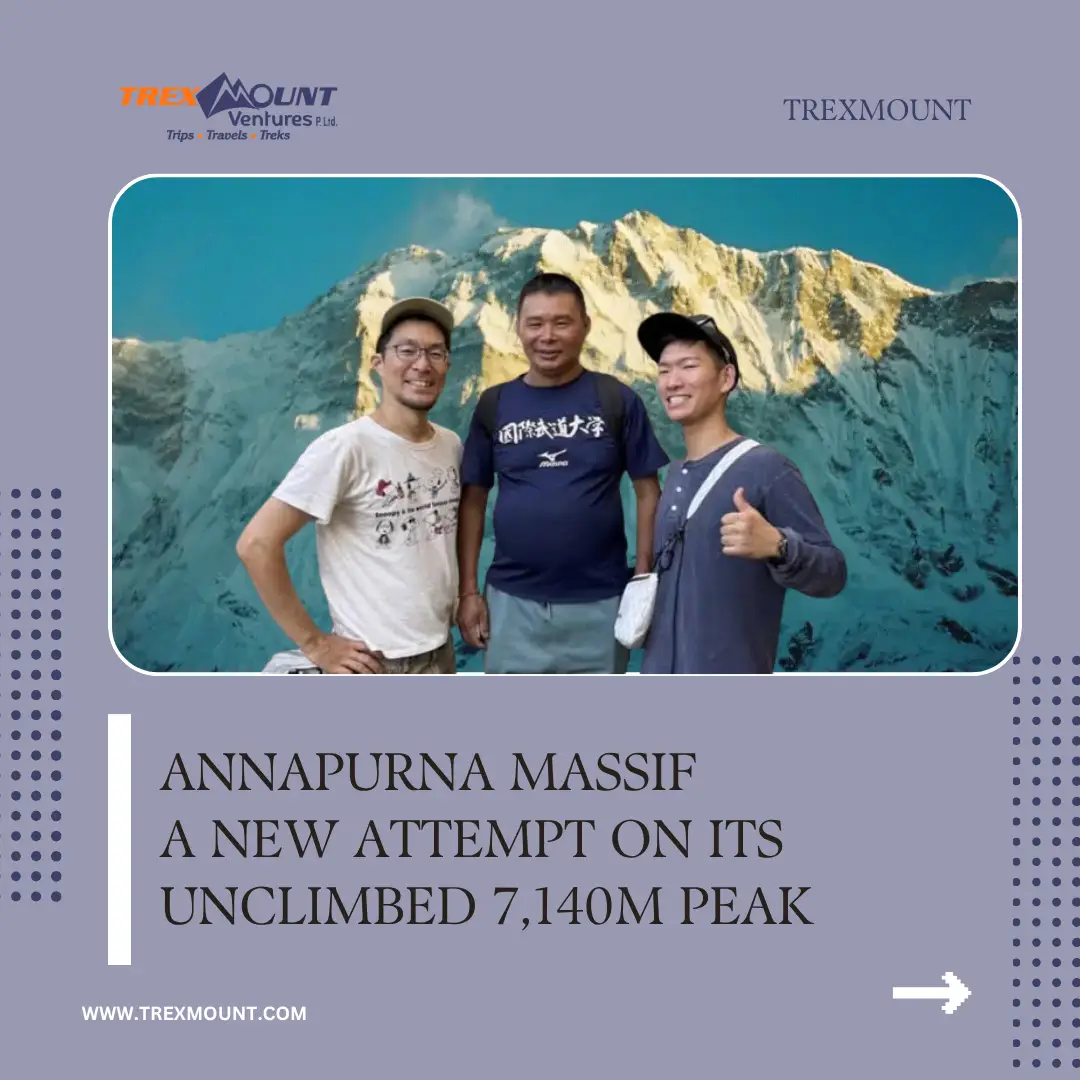
The Annapurna Massif is once again attracting attention from the international mountaineering community as Japanese climbers Hidesuke Taneishi and Tetsu Hashimoto head into Nepal with an ambitious objective: attempting the First Ascent of Gangapurna West, a 7,140m mountain that remains an Unclimbed Peak in the Annapurna Himal.
Located between Annapurna I and Annapurna III, Gangapurna West has resisted several serious expeditions since it was opened for climbing in 2014. The closest previous attempt reached the summit ridge and came to within approximately 100m of the top.
Now, more than a decade after the mountain was officially opened, Taneishi and Hashimoto are attempting to solve the remaining challenge in an alpine-style ascent. Their expedition brings a new chapter to the history of one of the Annapurna region's lesser-known but still unclimbed summits.
Gangapurna West rises to 7,140m (23,425ft) and lies west of Gangapurna, a 7,455m mountain on the Annapurna ridge. The peak is positioned between Annapurna I and Annapurna III, placing it within one of Nepal's most important high-altitude mountain groups.
The Himalayan Database lists Gangapurna West under the alternative names Lachenal Peak and Asapurna. It was officially opened to climbers in 2014, but its first ascent has yet to be recorded. The database currently lists three expeditions to the mountain, in 2016, 2017 and 2019, with no successful summit.
The name Lachenal Peak refers to French mountaineer Louis Lachenal, who was part of the historic 1950 expedition that made the first ascent of Annapurna I. The naming of Gangapurna West is also connected to the complicated history of peak names and mapping in this section of the Annapurna Himal.
This distinction is important because Gangapurna West should not be confused with Gangapurna itself. Gangapurna reaches approximately 7,455m and was first climbed in 1965. Gangapurna West is a separate summit and remains unclimbed.
The current expedition is being led by Japanese alpinists Hidesuke Taneishi and Tetsu Hashimoto.
According to the September 2026 reports, the pair are in Nepal to attempt the first ascent of Gangapurna West in alpine style. Recent reporting says the climbers have already begun their approach toward the mountain.
Rather than approaching Gangapurna West as a conventional large-scale commercial expedition, the objective is being pursued as a small-team alpine climb. Alpine-style climbing generally emphasizes carrying equipment between climbers, minimizing fixed infrastructure and moving through the mountain as a relatively self-contained team.
For an unclimbed summit, this approach also means that route decisions have to be made according to the conditions encountered on the mountain rather than simply following a heavily established commercial route.
The current expedition is particularly notable because Taneishi already has experience with exploratory climbing in Nepal.
In 2024, Taneishi and Hiroki Yamamoto made the first ascent of Pholesobi, a 6,652m Himalayan peak in Nepal. They climbed the mountain's north face in alpine style, completing a technically difficult new route. The Himalayan Database records the 2024 Phole first ascent by Hidesuke Taneishi and Hiroki Yamamoto.
The ascent subsequently received attention in the Piolets d'Or climbing community. Recent reporting on the Gangapurna West expedition identifies Taneishi's Pholesobi ascent as an important part of his background in exploratory Himalayan climbing.
That experience makes the current objective particularly relevant: Gangapurna West is another mountain where route-finding, conditions and self-sufficient climbing are likely to play an important role.
Although some initial reports of the current expedition refer to two previous attempts, the Himalayan Database records three expeditions to Gangapurna West: a South Korean attempt in 2016, an Italian attempt in 2017 and a U.S. attempt in 2019.
Each expedition approached the mountain differently, and each encountered its own set of difficulties.
The first documented attempt came in 2016, when South Korean climbers Kim Chang-ho, Choi Seok-mun and Park Joung-yong attempted the south face.
The team climbed onto the glacier before ascending a south-southwest-facing spur. They established their first bivouac at approximately 5,806m and then climbed steep snow and serac terrain toward a second bivouac around 6,200m.
After spending time studying the complicated glacier terrain above them, the climbers launched their summit attempt early on October 8.
Two members continued toward the summit ridge, while Park Joung-yong stopped because he was insufficiently acclimatized. Kim Chang-ho and Choi Seok-mun climbed several pitches farther and reached the summit ridge.
The summit was only around 100m higher.
However, the climbers decided not to continue without their teammate. They turned around, leaving Gangapurna West without a successful ascent.
The decision illustrates one of the defining characteristics of exploratory mountaineering: reaching a point close to the summit does not necessarily mean continuing is the correct choice. In this case, the team prioritized returning together over completing the summit.
During the same expedition, the Korean climbers also completed a new direct route on the south face of Gangapurna itself.
The following year, Italian climbers Simon Messner and Phillip Pruenster approached Gangapurna West from the north side.
Their planned route began from the Manang Valley, with Base Camp established at approximately 5,000m. Conditions initially appeared favorable, but the mountain carried substantial amounts of snow.
During their first acclimatization climb, the pair encountered snow ranging from knee to hip depth. They reached around 6,000m and decided to camp.
Before they could properly establish their tent, an avalanche swept them some distance. Neither climber was injured, and they spent the night before descending the following day.
After a period of bad weather, they made another attempt and reached approximately 6,200m. Heavy snowfall again became a problem, leaving their equipment wet and forcing them to descend.
Later, Messner returned toward the high camp while Pruenster was ill. When Messner arrived at the campsite, he discovered that their tent had disappeared, apparently swept away by another avalanche.
After searching for approximately two hours without finding it, the expedition was abandoned.
The attempt demonstrated how quickly conditions on a high Himalayan face can turn an apparently manageable route into an objective dominated by snow and avalanche hazards.
The third documented attempt came in 2019, when a seven-member American team led by Jason Kolaczkowski attempted the mountain.
The team planned to follow a modified version of the 2016 Korean route from the southeast spur. The approach was remote, and the team intended to climb without guides or Sherpa support above Base Camp. Asian Trekking provided logistical and Base Camp support.
The expedition eventually reached around 6,200m, but illness, injuries and climbing hazards forced the team to abandon the attempt.
The Himalayan Database records the 2019 expedition as a U.S. expedition on the southeast spur, using the 2016 Korean route.
This became the most recent documented attempt before the Japanese expedition in 2026.
Gangapurna West is not simply difficult because it is 7,140m high. Its climbing history shows a combination of factors that have repeatedly disrupted attempts.
The 2017 north-face attempt was directly affected by avalanches. An avalanche struck the Italian climbers around 6,000m, while another apparently swept away their tent at higher altitude.
Heavy snowfall repeatedly affected the 2017 expedition. Deep snow made progress slow, while subsequent snowfall left equipment wet and complicated further climbing.
The 2016 Korean expedition spent considerable time examining the glacier terrain above their high bivouac before launching its summit attempt.
The 2019 expedition also faced problems involving illness and injuries, contributing to its withdrawal.
These previous attempts show why the mountain continues to attract exploratory climbers despite its relatively modest elevation compared with Nepal's 8,000m peaks.
A first ascent is fundamentally different from climbing an established Himalayan route.
On a frequently climbed mountain, climbers may have access to detailed route descriptions, established camps, fixed ropes, previous photographs and extensive knowledge about hazards.
An Unclimbed Peak presents a different problem.
The team must determine:
This is why First Ascent attempts remain important in modern Himalayan climbing. The challenge is not simply reaching a particular altitude; it is finding and completing a viable route where no successful route to the summit has previously been established.
The Annapurna Massif contains some of the world's most famous mountains, but its mountaineering story extends well beyond Annapurna I.
Gangapurna itself, Annapurna III, Tarke Kang, Tare Kang and Gangapurna West occupy a complex network of ridges and summits. Historical mapping and naming have sometimes created confusion between neighboring peaks, which is why detailed records such as those compiled by the Himalayan Database and American Alpine Club are important when documenting expeditions.
The region also continues to attract climbers searching for new routes and unclimbed objectives rather than established commercial ascents.
Gangapurna West is an example of this continuing exploratory side of Himalayan mountaineering.
It is a 7,140m mountain that has been legally open to climbing since 2014, has received multiple serious attempts, and yet still has no recorded first ascent.
As of the latest September 2026 reports, Taneishi and Hashimoto have begun their approach, but there is not yet reliable confirmation of a successful summit or completed first ascent.
That distinction matters.
The current expedition is an attempt, not a confirmed ascent. Recent reporting from ExplorersWeb and other mountaineering sources identifies the objective as a first ascent of Gangapurna West, while the Himalayan Database continues to list the peak as unclimbed.
If successful, the Japanese team would add the first recorded summit of Gangapurna West to the climbing history of the Annapurna Massif.
For now, the mountain remains an open question.
After the Korean team came within roughly 100m of the summit in 2016, the Italians encountered avalanches in 2017 and the Americans were unsuccessful in 2019. The 2026 Japanese expedition now represents the next documented effort to reach the top of this 7,140m Unclimbed Peak.
Hidesuke Taneishi and Tetsu Hashimoto are attempting Gangapurna West, a 7,140m peak located west of Gangapurna between Annapurna I and Annapurna III. The Himalayan Database currently records the mountain as unclimbed.
No. Gangapurna West remains an Unclimbed Peak. The Himalayan Database records three previous expeditions, in 2016, 2017 and 2019, but no successful summit.
Gangapurna West was officially opened to climbers in 2014. It is also known as Lachenal Peak and Asapurna.
The 2016 South Korean team came closest. Kim Chang-ho and Choi Seok-mun reached the summit ridge and were approximately 100m below the summit before turning around.
The current expedition is being undertaken by Japanese climbers Hidesuke Taneishi and Tetsu Hashimoto. They intend to climb Gangapurna West in alpine style.
The Himalayan Database records three previous expeditions: South Korea in 2016, Italy in 2017 and the United States in 2019. Some recent reports have described only two earlier attempts, but the 2019 American expedition is documented in the Himalayan Database and other mountaineering sources.
Simon Messner and Phillip Pruenster attempted the north face but faced deep snow and avalanches. An avalanche struck them at around 6,000m, and a later avalanche apparently swept away their tent near the high camp. They ultimately abandoned the expedition.
No. Gangapurna is a separate 7,455m peak, while Gangapurna West is a 7,140m subsidiary summit west of it. Gangapurna was first climbed in 1965, while Gangapurna West remains unclimbed.
A First Ascent means making the first confirmed climb to the summit of a mountain or the first completion of a particular climbing route, depending on the context. For Gangapurna West, the current objective is the first successful ascent of the summit itself.
The expedition is significant because Gangapurna West remains one of the Unclimbed Peaks in the Annapurna region despite three documented attempts. A successful ascent would establish the first recorded summit of the 7,140m mountain and add a new chapter to the exploratory climbing history of the Annapurna Massif.
As of September 18, 2026, Gangapurna West remains listed as unclimbed, while Hidesuke Taneishi and Tetsu Hashimoto are undertaking the latest attempt at its First Ascent. The expedition has begun its approach, but no reliable source reviewed for this article has confirmed a successful summit.

Welcome to Trexmount Ventures !