 Trexmount Ventures
Trexmount Ventures
Trexmount Ventures

Popular Searches
Ready to plan your next getaway? Let’s connect and create something incredible together.
If you've ever typed "where is Kathmandu city" into a search bar, you're not alone. Despite being a capital city visited by millions each year, Kathmandu remains surprisingly misunderstood. Some assume it's a country of its own. Others place it in India or Tibet. And plenty of people mix it up with the larger Kathmandu Valley that surrounds it.
Whether you're booking your first trip to Nepal, writing a school report, or just satisfying your curiosity about world geography, this guide breaks down exactly where Kathmandu sits, on the world map, within Nepal, and inside its famous valley.
Part of the reason people struggle to answer where is Kathmandu Nepal comes down to the country's unusual geography. Nepal is landlocked, wedged tightly between two geographic giants, and much of its identity abroad is tied to the Himalayas rather than its capital city.
Instead, Kathmandu occupies a mountain-ringed valley shaped by centuries of trade, religion, and culture. To really understand where is Kathmandu city, it helps to look at it through three lenses: its place on the globe, its position inside Nepal, and its spot within the valley that shares its name.
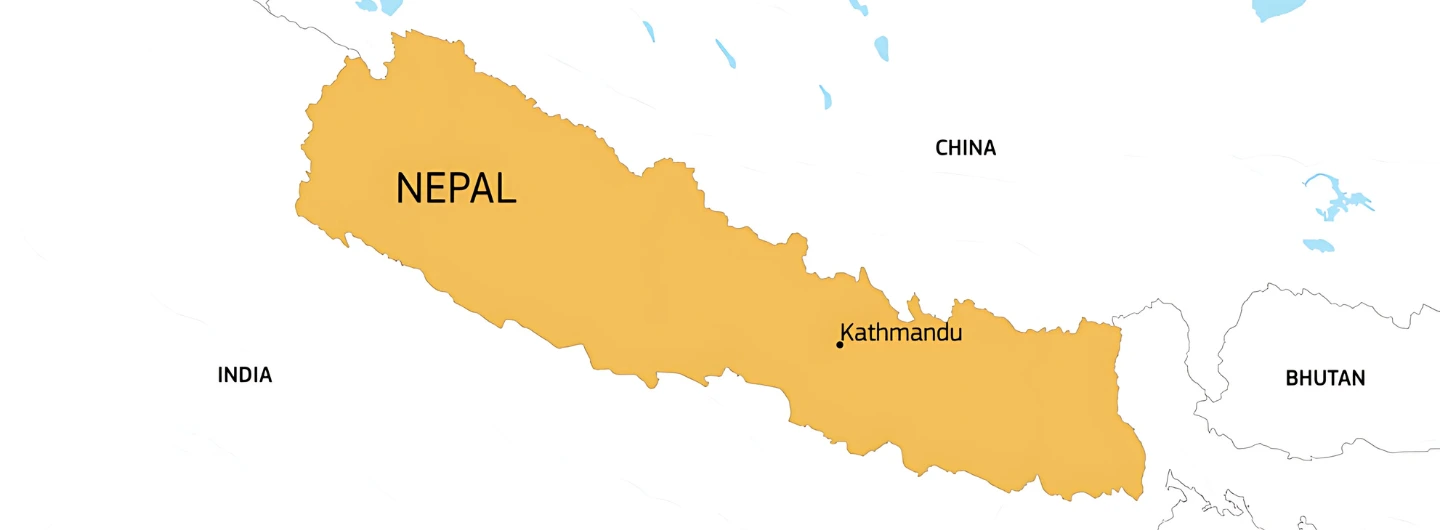
Zooming all the way out, here's the simplest answer to where is Kathmandu Nepal:
Nepal itself is sandwiched between two of the largest nations on Earth, India along its southern, eastern, and western borders, and China's Tibet Autonomous Region to the north. Kathmandu city sits well within Nepal's interior, closer to the southern half of the country rather than hugging either border directly.
In terms of exact geographic coordinates, Kathmandu is located at approximately:
These coordinates place the city in the northern hemisphere's subtropical zone, which is part of why Kathmandu enjoys a noticeably milder climate than the high-altitude regions elsewhere in Nepal.
So, in short: Kathmandu city is a South Asian capital, nestled inside Nepal, positioned between India and China, but not directly bordering either one.
Once you understand where Nepal itself sits, the next layer of the question, where is Kathmandu city within the country, becomes easier to answer.
Kathmandu functions as:
Geographically, Kathmandu occupies a central location in Nepal, which makes it reasonably accessible from both the eastern and western regions of the country. This central positioning is a big part of why it became the capital in the first place, long before highways or airports existed.
A few quick facts about its placement:
That last point matters more than it might seem. Long before Kathmandu was a modern capital, it was a crucial stop for merchants and travelers moving goods and ideas between South Asia and the Tibetan plateau, a role that helped the city grow into Nepal's cultural and economic center.
Here's where most of the confusion actually happens. People often use "Kathmandu city" and "Kathmandu Valley" interchangeably, but they're not the same thing, and that's exactly why so many people search "where is Kathmandu Valley " separately from the city itself.
The valley isn't just one city, it's home to three major urban centers:
Think of it this way:
Once you separate these two ideas, the earlier question about where is Kathmandu valley answers itself: it's the larger bowl of land that Kathmandu city, along with its neighboring cities, calls home.
A common assumption is that Kathmandu sits directly inside the Himalayas. It doesn't.
That said, the connection to the Himalayas is still very real:
This makes Kathmandu less of a mountain city and more of a gateway city, the launching point most travelers use before heading into the high mountains for trekking or climbing.
Understanding where is Kathmandu city isn't just about pins on a map, it explains why the city became so historically and culturally significant.
The valley's natural geography offered real advantages:
Because of these advantages, Kathmandu developed into a hub for:
Religious significance plays a huge role here too. Kathmandu sits along historic pilgrimage routes, which is part of why it holds such deep spiritual meaning for both Hindus and Buddhists. Some of its most recognized landmarks include:
These sites are a major reason travelers from around the world continue to look up where is Kathmandu Nepal, the city's spiritual pull reaches well beyond its physical borders.
Knowing where Kathmandu sits is only half the picture, getting there is the other half.
From Kathmandu, travelers can easily continue on to:
This central hub role reinforces Kathmandu's importance, not just as a destination, but as the starting point for nearly every journey across Nepal.
To sum it all up:
Kathmandu city sits in central Nepal, within South Asia, positioned between India and China. It's located inside Kathmandu Valley and serves as the country's capital.
Kathmandu Valley surrounds Kathmandu city. The city is one part of the valley, which also includes Lalitpur and Bhaktapur.
Nepal is located in South Asia, and within it, Kathmandu city sits in the country's central region.
No, Kathmandu is located in Nepal, a separate country that happens to border both India and China.
Not directly. Kathmandu serves as the main gateway for Everest expeditions, but the Everest region itself is several hours away by flight and further trekking.
Because Kathmandu city physically sits inside Kathmandu Valley, the two names are frequently used interchangeably in travel writing and everyday conversation, even though they technically refer to different things.
Answering where is Kathmandu city takes more than pointing to a spot on a map. It means understanding Nepal's geography, its position between two major powers, and the valley that has shaped its culture and history for centuries. Kathmandu's location isn't just a geographic fact, it's the foundation of everything that makes the city worth visiting, from its temples and trade history to its role as the gateway to the Himalayas.
If a trip to Nepal is on your radar, understanding exactly where Kathmandu sits and how it relates to the valley and country around it is a solid first step before you start planning the rest of your itinerary.

Welcome to Trexmount Ventures !