 Trexmount Ventures
Trexmount Ventures
Trexmount Ventures

Popular Searches
Ready to plan your next getaway? Let’s connect and create something incredible together.
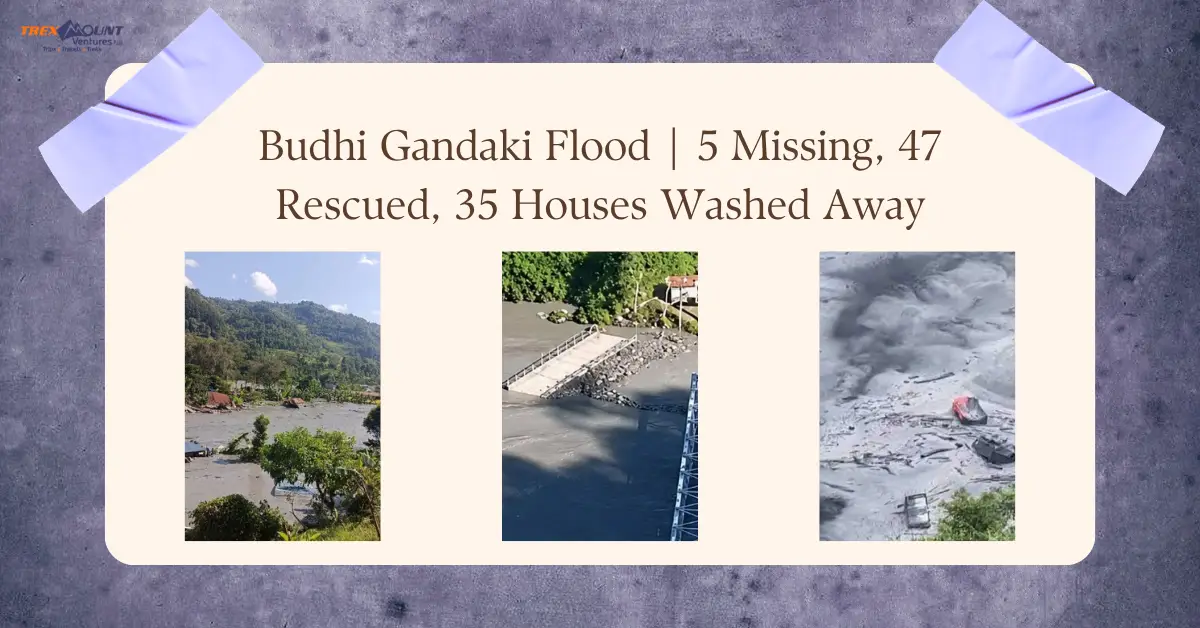
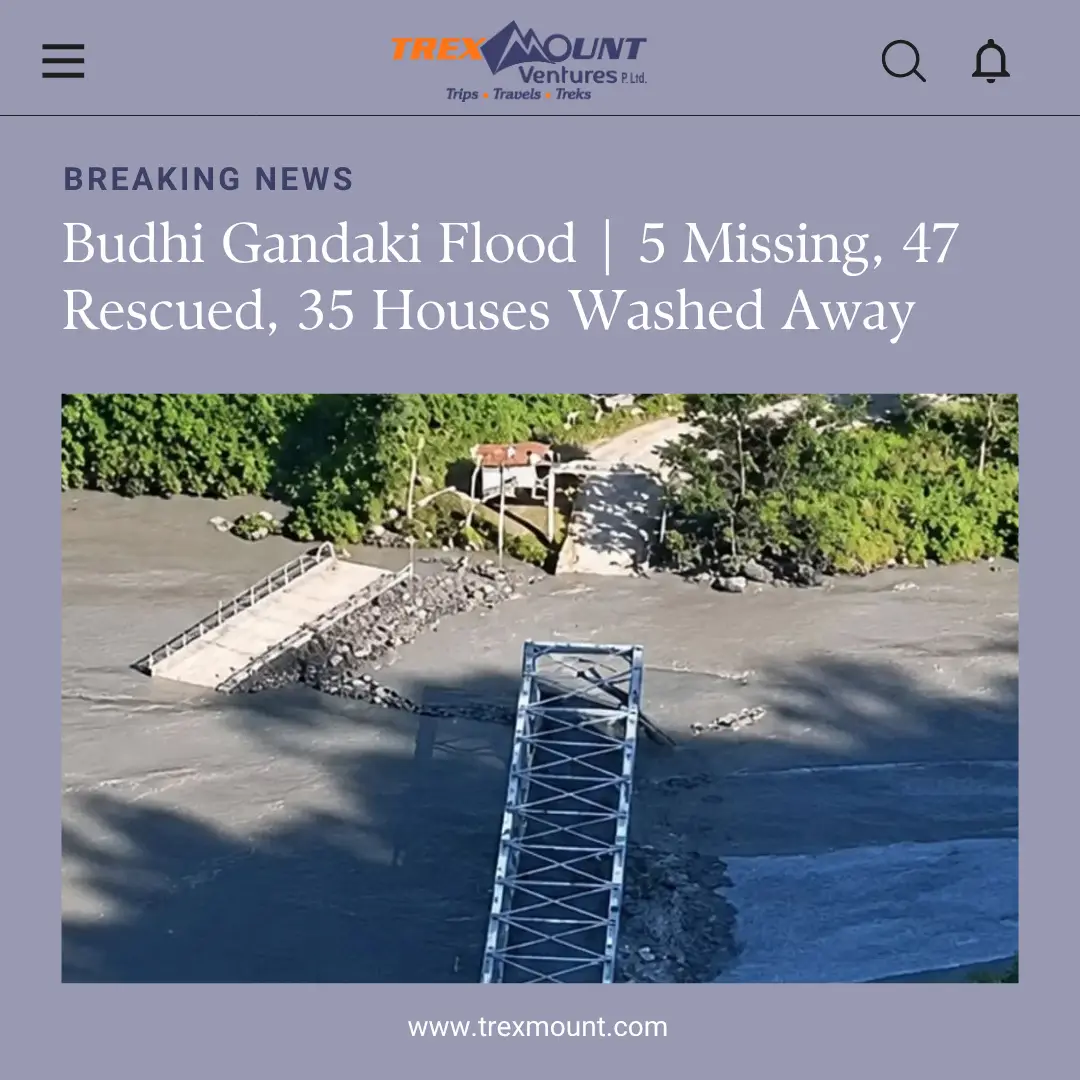
The Budhi Gandaki Flood in Gorkha district, Nepal, caused serious damage to homes, bridges, and other infrastructure on Sunday, October 11, 2026. According to reports published by The Himalayan Times, the flood followed a landslide that blocked the Budhi Gandaki River and triggered a sudden flow of water, mud, and debris through nearby settlements.
The disaster left five people missing, while 47 people were rescued from affected areas by Nepal Army helicopters. A separate report stated that 35 houses in Paiyu and Bagar villages of Chumanubri Rural Municipality were washed away.
The incident also damaged bridges, electricity poles, telephone towers, and infrastructure connected to a hydropower project. Rescue teams and local authorities responded by evacuating residents, issuing flood warnings, and delivering essential relief supplies.
The flood occurred early on Sunday morning, October 11, 2026. According to The Himalayan Times, the water rose after a landslide blocked the Budhi Gandaki River between Lokpa and Chumling in Ward 6 of Chumnubri Rural Municipality.
The blockage caused a large amount of water to surge through the river area, carrying mud and debris. Nearby villages experienced damage to houses, bridges, and other infrastructure.
The first report, published at 9:18 a.m., stated that 35 houses had been washed away in Paiyu and Bagar villages. It also reported that residents had fled to safer places and that authorities had not yet completed a detailed damage assessment.
A later report, published at 3:14 p.m., provided further information about the landslide, the five missing people, the rescue of 47 people, and the wider damage caused by the flood.
One of the most serious concerns following the Budhi Gandaki Flood was the report of five missing people. According to the National Disaster Risk Reduction and Management Authority (NDRRMA), the missing individuals were two women and three men who had been staying at a sheepfold in Ungiling, Chumchet, within Chumnubri Rural Municipality.
The Nepal Army deployed four helicopters to support search and rescue operations and evacuate people from affected areas.
According to the NDRRMA report published on October 11:
These figures describe the situation reported on October 11, 2026. They should not be interpreted as the final outcome of the search and rescue operation, because the cited reports do not establish the eventual status of the missing people.
The destruction of homes was among the most visible impacts of the flood. The morning report by The Himalayan Times stated that 35 houses in Paiyu and Bagar villages of Chumanubri Rural Municipality were washed away.
The flood also affected several other settlements, including Dobhan, Ghattekhola, Jagat, and Salleri. Damage was reported in the market area of Ward 3 as well.
The loss of houses creates serious challenges for affected families. People who lose their homes may need temporary shelter, food, clothing, and other essential supplies while authorities assess the damage and organise relief efforts.
However, the two reports do not provide a complete breakdown of how many families were displaced, the total financial value of the damage, or the final number of homes affected across the entire flood zone. These details should be confirmed through subsequent official assessments.
The Budhi Gandaki Flood affected more than just residential areas. Several bridges and important infrastructure were also damaged or swept away, creating additional challenges for people living in the region.
According to NDRRMA information reported by The Himalayan Times, the following damage was recorded:
This damage is significant because bridges, roads, electricity, and communication networks are essential for reaching remote communities. When these services are disrupted, it can become more difficult for residents to travel, receive emergency assistance, and access basic supplies.
The Budhi Gandaki River is an important geographical feature of Gorkha district. However, the October 11 incident showed how quickly a landslide-related river blockage can create dangerous conditions for nearby settlements.
In this case, the landslide between Lokpa and Chumling blocked the river, leading to a sudden flood carrying mud and debris. The resulting water flow affected homes, bridges, and infrastructure in several locations.
The incident also raised concerns beyond the immediate area because authorities issued warnings to communities along the river.
Residents were advised to remain in safe locations and avoid dangerous bridges and roads. Police also urged people in several settlements, including Khorlabensi, Machhakhola, Soti, Arkhet, and Arughat, to move to safer places because of the continuing risk.
When a landslide blocks a river, rocks, soil, and debris can temporarily prevent water from flowing normally. Water may accumulate behind the blockage. If the blockage gives way, a sudden surge of water can travel downstream.
The exact sequence and contributing factors must be established through technical investigation in each incident. In the Gorkha case, the NDRRMA reported that the landslide blocked the Budhi Gandaki River and triggered the flood.
This type of event highlights the importance of:
Following the disaster, government agencies and security personnel coordinated rescue, evacuation, monitoring, and relief activities.
The NDRRMA reported that 437 security personnel had been mobilised, including 127 personnel from the Nepal Army, 133 from Nepal Police, and 177 from the Armed Police Force. Another 50-member Nepal Police team was on standby.
Police personnel were deployed to warn riverside residents and help move them to safer locations. Twelve employees of Times Urja in Salleri were also evacuated.
The response included several additional measures:
These actions were reported by the NDRRMA through The Himalayan Times on October 11, 2026. The reports do not confirm when all damaged infrastructure will be restored or when every affected household will receive assistance.
Flood conditions can change quickly, particularly when a river is affected by a landslide or heavy debris. People living near the Budhi Gandaki River should follow official instructions rather than relying on assumptions about the water level.
Based on the safety advice issued by the NDRRMA, residents should:
People should not attempt to cross a flooded river or inspect damaged bridges themselves. Even when water levels appear to have fallen, debris, unstable ground, and damaged structures may still present serious risks.
For the October 11 incident, the NDRRMA specifically advised residents along the Budhi Gandaki River to remain in safe locations through Sunday evening and avoid risky bridges and roads. Anyone seeking current travel or safety information should check the latest official notices rather than relying only on the initial news reports.
The impact of the Budhi Gandaki Flood extends beyond the immediate destruction caused by the water. The loss of houses can disrupt family life, while damaged bridges and electricity infrastructure can make daily activities more difficult.
Communities in remote areas may face additional challenges when transport links are damaged. Emergency workers may need to use helicopters or alternative routes to reach affected locations, and restoring bridges can require technical assessments before reconstruction begins.
The damage reported in Gorkha also demonstrates why accurate information and early warnings are important in areas exposed to landslides and river flooding.
At the same time, it is important not to draw conclusions that the available reports cannot support. The full scale of the damage, the final status of the five missing people, and the timeline for recovery were not established in the two reports published on October 11, 2026.
Further updates from the relevant government authorities will be needed to understand the complete human and economic impact of the disaster.
The Budhi Gandaki Flood in Gorkha on October 11, 2026, caused serious damage to homes, bridges, and public infrastructure. Reports stated that five people were missing, 47 had been rescued, and 35 houses in Paiyu and Bagar villages had been washed away. The flood followed a landslide that blocked the Budhi Gandaki River and sent water, mud, and debris through affected areas.
Government authorities and security personnel responded with helicopter rescues, evacuation efforts, early-warning messages, relief supplies, and technical assessments. However, the full extent of the damage and the eventual outcome of the search for the missing people remained unconfirmed in the cited reports.
The immediate priority is the safety of people living near the river, followed by a reliable assessment of the damage and support for affected communities. Residents should follow official warnings and avoid unsafe roads, bridges, and river crossings while emergency operations continue.
This article is based on reports published by The Himalayan Times on October 11, 2026, drawing on information from the NDRRMA, local authorities, police, and RSS. Figures reflect the reporting available that day and may change as official assessments are updated.
A landslide blocked the Budhi Gandaki River on October 11, 2026, triggering a flood that carried water, mud, and debris through nearby settlements. The flood damaged houses, bridges, and other infrastructure.
Five people were reported missing in the NDRRMA update published on October 11, 2026. They were two women and three men staying at a sheepfold in Ungiling, Chumchet.
According to the NDRRMA, 47 people were rescued from affected areas by Nepal Army helicopters.
The Himalayan Times reported that 35 houses in Paiyu and Bagar villages of Chumanubri Rural Municipality were washed away by the flood. Additional damage to houses was reported in other locations.
According to the NDRRMA, a landslide between Lokpa and Chumling in Chumnubri Rural Municipality blocked the Budhi Gandaki River and triggered a flood carrying mud and debris.
Reportedly affected areas included Paiyu, Bagar, Dobhan, Ghattekhola, Jagat, Salleri, Nyakchet, Sirdibas, Machhikhola, and parts of Arughat. The reports also identified damage to bridges and infrastructure in Dharche Rural Municipality.
Yes. Several bridges were swept away or damaged, including bridges connecting Nyakchet and Sirdibas, Machhikhola and Kerauja, Gorkha and Dhading at Naya Pul, and Wards 2 and 3 in Soti, Arughat.
The Nepal Army deployed four helicopters to support rescue and evacuation operations. Security personnel were mobilised, early-warning messages were issued, relief supplies were transported, and technical teams were deployed to investigate the incident and assess infrastructure damage.
The two reports do not establish that all affected areas are safe for travel. The NDRRMA advised residents to remain in safe locations and avoid risky bridges and roads. Travellers should check current official notices and local road conditions before entering affected areas.
People can follow updates from the National Disaster Risk Reduction and Management Authority, local government offices, police, and established news outlets such as The Himalayan Times. For travel decisions, current local safety information should take priority over older reports.

Welcome to Trexmount Ventures !